Skip to content

Help us to think about the future of St Just Miners’ Chapel and the changes it needs to remain a strong symbol of our shared heritage, culture and community while also making sure it is well maintained, warmer and can continue to be welcoming and used by the whole community for gathering, learning, celebration and creativity. 

In this section you’ll find background information, design principles guiding our approach and decisions about the future, and the carefully considered adaptations that we think will enable the Miners’ Chapel to thrive safely, sensitively and sustainably for generations to come.

Thanks to your support and a grant from the Community Ownership Fund, in August 2025 we were able to save the building for the community.

Today we face the same challenge as those who came before us: How do we protect this landmark’s historic character while ensuring it remains useful, welcoming, and sustainable for the next 100 years?

The Chapel has always evolved in response to community needs in the same way as St Just has always adapted.

The Chapel’s future depends on continuing that tradition with care. 

This is our moment to shape the 100 years. 

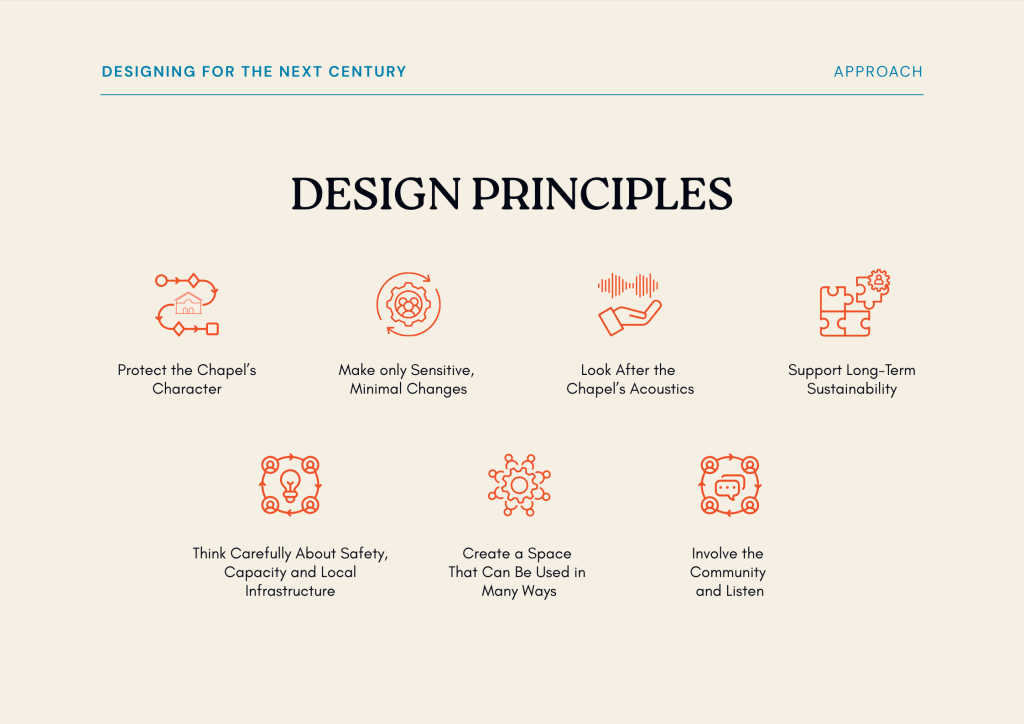
Our Design Principles

Trustee decisions are guided by a clear set of design principles. 

1. Protect the Chapel’s Character: We want the Chapel to continue to feel like the place of worship and gathering that matters deeply to people. Key historic features will stay, and any new elements will be designed to sit comfortably within the building’s unique look and feel.

2. Make Only Sensitive, Minimal Changes: Any changes we make will be careful and respectful. We aim to do only what is necessary to secure the Chapel’s future.

3. Create a Space That Can Be Used in Many Different Ways: Introducing good-quality, moveable seating will allow the Chapel to host a much wider range of community and cultural activities — from concerts, creative performance and gatherings to worship, celebrations, and learning. Flexibility is key to making the Chapel useful all year round.

4. Support Long-Term Sustainability: These decisions are about securing the Chapel for the next century. Being able to host a variety of events will help bring in income, reduce reliance on grants, and ensure the Chapel remains a living, active part of the community. It also means the Chapel will offer something different from other local venues, helping us complement what already exists rather than compete with it.

5. Think Carefully About Safety, Capacity, and Local Infrastructure: We will design the space so it is safe, comfortable, and works well for different group sizes. This includes looking closely at capacity, access, and fire safety. We are also planning with local infrastructure in mind — from parking to how people arrive, move around, and leave the Chapel so that our plans work well for the community as a whole.

6. Look After the Chapel’s Acoustics: Good sound is essential for music, performance, and spoken events. Plans to remove the downstairs pews, will make sure that whatever replaces them supports the Chapel’s natural acoustic qualities. Choices in fabrics and materials will also be made with sound in mind.

7. Involve the Community and Listen: We want local people, partners, and heritage bodies to be part of this journey. We will share ideas and explain clearly why decisions are being made. We’re committed to working openly and respectfully.

Our Approach to Materials, Sound, Light and Accessibility

Materials – Natural, Timeless, Sustainable

We’re choosing materials that sit comfortably alongside the Chapel’s historic fabric:

  • Oak joinery
  • Brass handrails
  • Limewash finishes
  • Lightweight, reversible glazing
  • Reuse of pew timber where possible

Why? To reduce waste, respect the Chapel’s architectural character, and ensure new work feels “at home”.


Acoustics & Lighting – Honouring the Chapel’s Sound

  • Natural acoustics are kept intact
  • Discreet curtains allow softening for spoken word and smaller gatherings
  • Lighting is subtle and flexible, with different modes for worship, performance or exhibitions

Why? People love singing and performing here for a reason. We want to keep that magic.


Accessibility – A Building That Welcomes Everyone

The Chapel should be easy and comfortable to use for all ages, abilities and sensory needs. We are desiging to ensure:

  • Clear sightlines and signage
  • Comfortable, non-glare lighting
  • Logical circulation routes
  • More inclusive facilities
  • Calming, quieter spaces
  • Better movement between Chapel and Annexe

Why? To make the Chapel feel safe, calm and inclusive for the whole community.

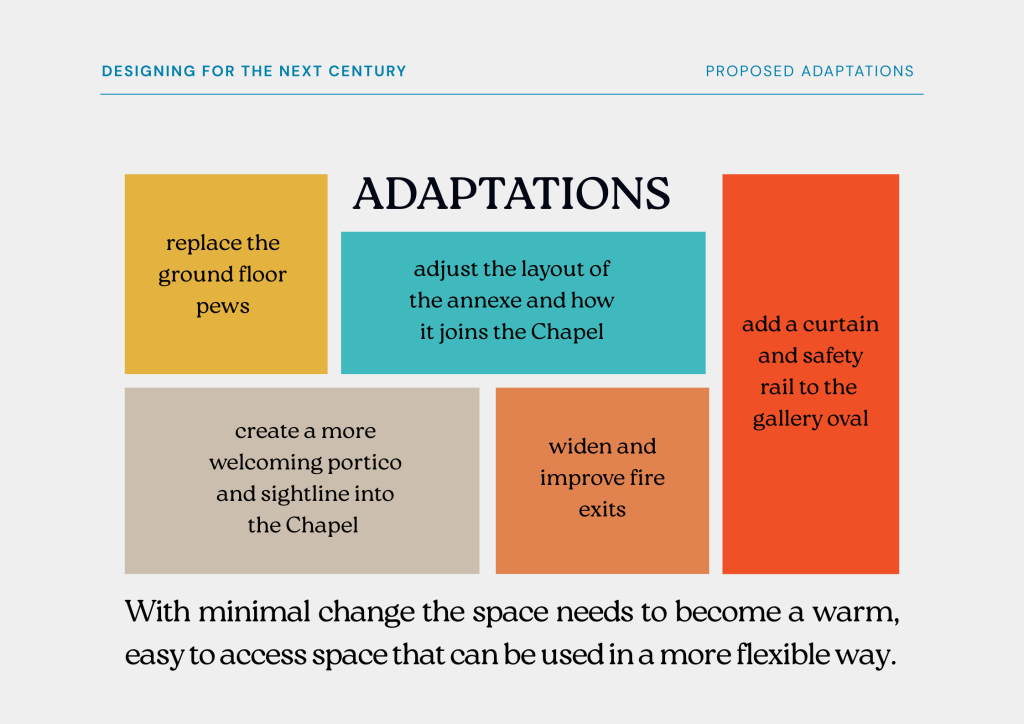
Opposite is a summary of the five proposed adaptations.

Scroll down to read about each of them in more detail and to VOTE on these five key adaptations.

Each adaptation links directly to the design principles and material choices you have read about in the ‘Our Approach’ tab. 

“The strength of the Miners’ Chapel’s identity comes from the three hundred years of the people who brought it to every next moment.”

Ground Floor Pews

Replacing fixed pews with carefully crafted, flexible seating made from the pitch pine of the removed fixed pews and design in contemporary floor markings to show where the fixed pews were and their numbers. 

Guiding Design Principle:
Protect the Chapel’s character while enabling flexible community use.

VOTE 🗳️

Select from YES/NO to vote on this proposal.

Replace the groundfloor pews with chairs made from the removed pews and well designed floor markings to represent where the pews once were.

Why this is needed:

  • Creates a level floor for better access

  • Offers multiple layouts (performance, ceremonies, gatherings)

  • Supports hire opportunities that sustain the building

  • Provides more comfort and space

  • Reuses pew timber in new elements

Annexe Layout & New Entrance

Enclosing the external yard, enlarging the window opening, and improving the link between buildings.

Guiding Design Principle:
Improve connection and flow in a discreet, low-impact way.

VOTE 🗳️

Select from YES/NO to vote on this proposal.

Reformat the Annexe (community hall) and introduce renewables

Why this is needed:

  • Creates a practical foyer for large events

  • Improves movement and flow between spaces

  • Allows for more accessible WC facilities

  • Improves natural light and sightlines

  • Enhances sustainability by reducing heat loss

The Portico – New Internal Lobby

Introducing a lightweight glazed lobby inside the existing granite portico.

Guiding Design Principle:
Fully reversible intervention that protects historic fabric.

VOTE 🗳️

Select from YES/NO to vote on this proposal.

Introduce a carefully designed glass enclosure within the Portico as a new lobby and entrance

Why this is needed:

  • Reduces heat loss and drafts

  • Creates a warm, welcoming entrance

  • Allows passersby a view into the building

  • Keeps the granite portico fully visible and untouched

Fire Exits & Access

Widening fire exits and adding a new one to meet safety standards.

Guiding Design Principle:
Safety and capacity improvements delivered with heritage sensitivity.

VOTE 🗳️

Select from YES/NO to vote on this proposal.

Improve emergency exits

Why this is needed:

  • Ensures safe evacuation for larger audiences

  • Supports a licensing system suitable for concerts and events

  • Makes the Chapel safer for everyone

  • Avoids putting pressure on the main entrance

  • Designed sensitively to avoid affecting the Chapel’s character

The Gallery Oval – Curtain & Safety Rail

A subtle curtain beneath the gallery and a lightweight guardrail for safety.

Guiding Design Principle:
Minimal, reversible changes that improve safety and acoustic comfort.

VOTE 🗳️

Select from YES/NO to vote on this proposal.

Introduce a safety rail and install a curtain

Why this is needed:

  • Allows flexible separation of space

  • Reduces echo when needed without affecting natural acoustics

  • Meets modern safety standards for public buildings

  • Minimal visual impact